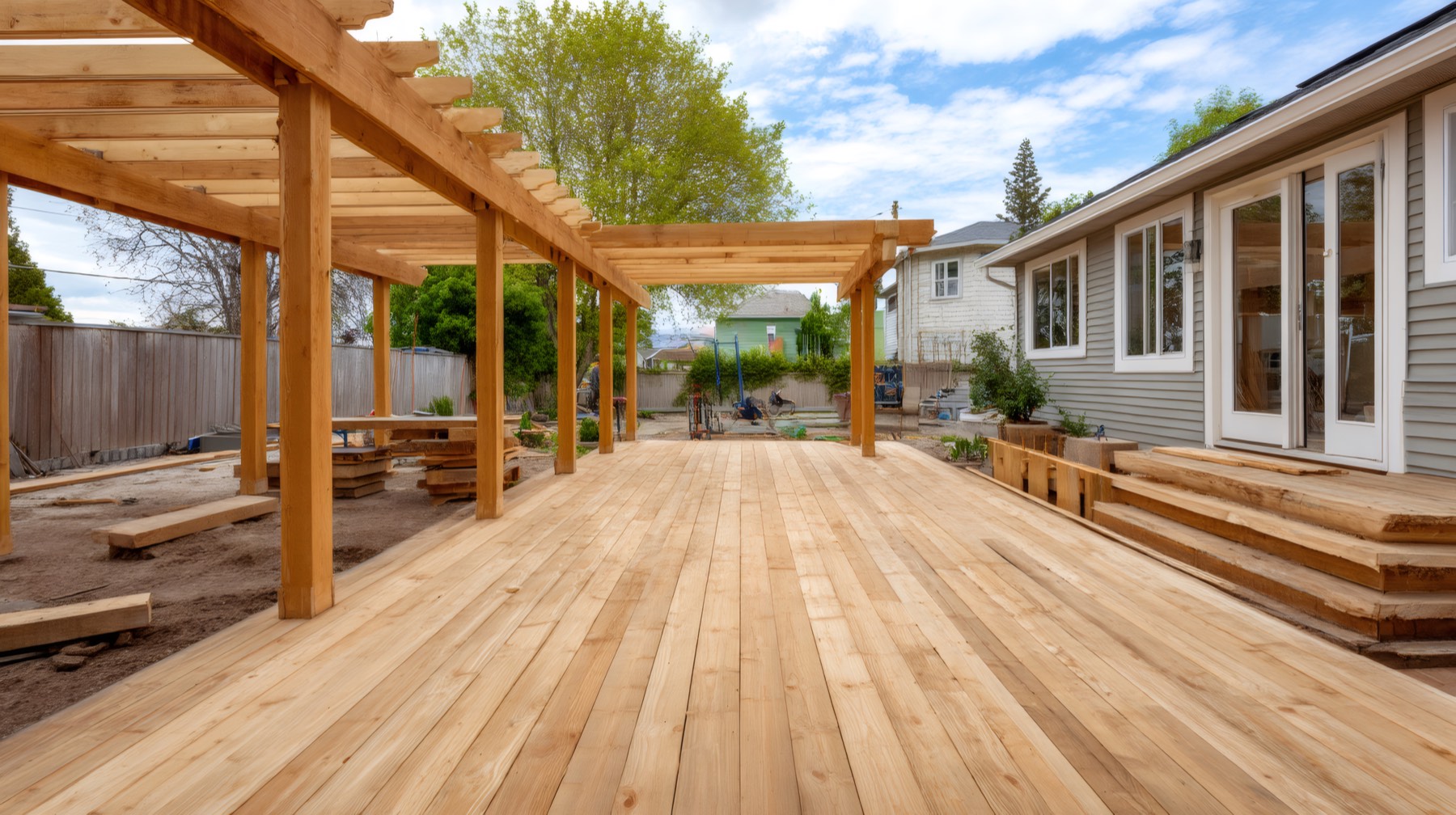
Pergolas, solid roof covers, and open-beam structures
We help you choose the cover type that matches how much weather protection you actually want and what fits the house.
Deck Services
Covered deck building for Everett and Snohomish County homeowners who want to use their outdoor space through rain, not just on the handful of dry summer days the Pacific Northwest actually delivers.
We help you choose the cover type that matches how much weather protection you actually want and what fits the house.
The structure overhead and the deck surface below are planned together so the finished space works as one project.
You get a real visit, an honest recommendation, and a written estimate that includes the structural and permit side too.
About the Service
Most parts of the country build covered decks as a luxury upgrade. In Everett, they're closer to a practical decision.
The Puget Sound area gets consistent rain from October through April — and honestly, into May in a normal year. An uncovered deck in the backyard looks nice in a listing photo, but if you're only willing to use it when it's dry, you're getting maybe four months of real use out of it annually.
A covered deck changes that math. A well-designed cover lets you sit outside in the rain with a cup of coffee in November, grill in March without getting soaked, and run a dining area through October without watching it get rained out. In Everett's climate, that's not a luxury — it's a meaningful improvement in how much you actually use the space you paid to build.
We design and build covered decks across Everett and Snohomish County for homeowners who've done the math and decided they want a deck that earns its keep through more of the year.
Cover Types
Covered deck covers a range of structures, and the right one depends on what you're trying to do, how the house is oriented, and what your budget allows. Here's how the main options compare:
Deck Surface Options
A covered deck needs the same careful surface material selection as any other deck build — the cover changes some of the moisture dynamics but doesn't eliminate them entirely.
Cedar
Cedar works well under a covered structure. The reduced direct rain exposure means cedar under a solid cover or pergola stays looking better longer between maintenance cycles. That said, covered decks in Everett can still deal with wind-driven moisture, condensation, and the general dampness of a Pacific Northwest winter — cedar still needs periodic sealing, just less frequently than a fully exposed deck.
Composite decking
Composite decking pairs naturally with a covered deck build. If you're already committing to a covered structure for low-maintenance outdoor living, composite boards extend that logic to the surface — you get a space that doesn't require sealing, staining, or much attention beyond an annual rinse. For covered decks intended for year-round dining or entertaining, composite is the most popular surface choice.
Pressure-treated framing
Pressure-treated framing goes under both regardless of the surface you choose. The structural frame — joists, beams, posts — is always pressure-treated for outdoor exposure and ground contact. That doesn't change with a covered structure.
We go through the surface material decision during the estimate visit and bring samples so you can see the options in your actual yard, in the light the deck will live in.
Permits and Structural Planning
This section matters more for covered decks than for standard open decks, so it's worth addressing directly.
Most covered deck additions in Everett require a building permit — and typically a more detailed one than a standard deck build. A pergola attached to the house, a polycarbonate panel roof structure, or a solid covered roof all trigger permit requirements that involve structural review, connection details, and sometimes engineering depending on the span and load.
We handle the permit application as part of every covered deck project. That includes preparing the site plan, structural details, and any documentation required by the City of Everett or Snohomish County — depending on where your property is located. You don't need to manage that process separately.
The ledger connection deserves specific attention on covered deck structures. A covered deck that's attached to the house transfers more load to the connection point than an open deck. If that connection isn't properly flashed and detailed, it becomes a water infiltration point — moisture gets behind the siding, into the framing, and causes the kind of damage that's expensive to repair. We plan the connection detail before we start, not as an afterthought when we're already framing.
Our Process
We come to your property and look at the yard, the house orientation, and how the covered area would connect. Sun angle, drainage, the roof line of the house, any setback requirements from the property edge — all of it shapes what kind of covered structure makes sense and how it should be positioned.
For covered decks specifically, we also look at how the roof or pergola will drain. Water running off a covered structure needs somewhere to go — into a gutter, away from the house foundation, away from the fence line. Planning drainage at the design stage prevents problems that are harder to fix after the structure is built.
After the visit we put together a written estimate with the scope, cover type, surface materials, and timeline. We go through the pergola vs. polycarbonate vs. solid roof comparison in the context of your specific yard and goals — not as a general overview but as a recommendation for what makes sense for your situation.
We also confirm permit requirements at this stage and include the application process in the project scope.
Once you approve the estimate we handle the permit submission, confirm material orders, and give you a realistic start date. Covered deck permits in Everett typically take longer to process than standard deck permits — we account for that in the timeline so the schedule doesn't depend on a permit turnaround we can't guarantee.
The crew arrives on schedule. We set posts and footings to the correct depth for the load and soil conditions, build the deck frame with proper joist spacing, install the surface boards, and then build the cover structure from the ground up. On attached structures, the ledger connection and flashing are done before the cover framing goes up — in the right order, not as an afterthought.
If anything unexpected comes up during the build, we stop and show you before making a decision that affects the structure.
When the work is done we walk the full structure with you — the deck surface, railings, post bases, cover frame, and the connection point at the house. We check that drainage is working as planned, that fasteners and hardware are solid, and that everything looks and functions the way it should. We clean the site completely before we leave.
Local Experience
Most of our covered deck work is in Everett and the surrounding Snohomish County communities — Marysville, Snohomish, Mill Creek, Mukilteo, Lynnwood, Edmonds, and Bothell. We also build covered structures in Shoreline, Kenmore, Kirkland, Redmond, and Issaquah.
The Everett area has a few specific conditions that affect covered deck design. Properties near the waterfront in north Everett deal with more wind load than inland yards — cover structures there need more attention to post sizing, anchor hardware, and connection details. Hillside properties in areas like Silver Lake or the Paine Field neighborhood sometimes have slope and drainage considerations that affect where a covered structure can sit relative to the house and yard grade.
We've also dealt with the permit requirements across different jurisdictions in this area. City of Everett permits for covered structures involve structural documentation that takes more preparation than a standard deck application. Snohomish County unincorporated permits work differently again. We know the process in the jurisdictions where we work regularly, which means fewer surprises and a more realistic timeline estimate upfront.
Why Choose Us
Covered decks are more complex than standard deck builds. They involve more structural planning, a more involved permit process, and connection details at the house that have real consequences if they're done incorrectly. This is a project where experience with the specific type of work matters more than it does on a straightforward platform deck.
We've built covered deck structures across Snohomish County — pergolas, polycarbonate roof covers, solid attached structures, and freestanding covered areas. We've also seen the versions of these projects that were done wrong — improper ledger flashing, undersized posts, drainage that runs toward the house — and we know what to do differently.
The people who give you the estimate are the same people who build the project. The structural details discussed during the planning conversation don't get lost between the office and the job site.
What homeowners who've worked with us tend to mention
We're also straightforward about what a covered deck won't do. A pergola with open rafters won't keep you dry in a hard Everett rain. A polycarbonate roof will, but it's a different look. We talk through what you're actually trying to accomplish and recommend accordingly.
FAQ
Yes, in almost all cases. Covered deck structures — pergolas, polycarbonate roof panels, solid roof additions — require a building permit in Everett, typically with more documentation than a standard open deck. The permit involves structural review, connection details, and sometimes engineering depending on the span and cover type. We handle the permit application as part of the project. You don't need to manage that process separately.
A pergola is an open-beam overhead structure — it gives the space a defined outdoor room feel and filters sun and light rain, but doesn't fully block a Pacific Northwest downpour. A covered deck has a solid or semi-solid roof — polycarbonate panels, metal roofing, or a built roof structure — that provides real rain protection. We build both, and we help homeowners figure out which one matches their goals and budget during the estimate visit.
Most covered deck builds in Everett take two to three weeks once permits are in place and materials are confirmed. Larger or more complex structures — solid roof additions, multi-level covered areas, projects with significant framing tied into the house — may take longer. The permit process for covered structures takes more time than a standard deck permit, so we build that into the schedule upfront rather than treating it as a variable that gets figured out later.
Yes, and this is a common project. If the existing deck is structurally sound and the posts or framing can support a cover, adding a pergola or roof structure to an existing deck is straightforward. If the existing deck needs reinforcement — heavier posts, additional footings, ledger upgrades — we assess that during the estimate and include it in the scope. We give you an honest picture of what the existing deck can support before recommending an approach.
Composite is the most popular choice for covered decks because it pairs logically with the low-maintenance goal of a covered structure. Cedar is a good option too — reduced direct rain exposure means cedar under a cover lasts longer between maintenance cycles than a fully exposed cedar deck. We go through the specific trade-offs during the estimate visit.
The range is wide depending on cover type, size, surface material, and site conditions. A basic cedar pergola over an existing deck is a different project than a solid roof covered deck built from scratch on a sloped lot. The most accurate number comes from an on-site visit where we can look at what's actually there and plan accordingly. The estimate is free and there's no obligation attached to it.
If you're thinking about a covered deck, pergola, or outdoor roof structure for your Everett-area home, the first step is a free on-site visit. We come to your property, look at the yard and house orientation, and put together a clear written estimate with cover options, surface materials, permit requirements, and a realistic timeline.
No phone guesses. No pressure to decide on the spot.
Call (425) 645-9799 or fill out the estimate request form and we'll get back to you within one business day.
We serve Everett, Marysville, Snohomish, Mill Creek, Mukilteo, Lynnwood, Edmonds, Bothell, Kenmore, Shoreline, Kirkland, Redmond, Bellevue, Issaquah, and surrounding Snohomish County communities.
Recent Projects
Deck Construction
Deck Build
Outdoor Living